




Communication technology has never been more accessible. From smartphones and push-to-talk applications to Wi-Fi platforms and professional two-way radio systems, organizations have more options than ever before for keeping teams connected.
Yet for operations leaders, more choice doesn't necessarily make the decision easier.
When communications become critical
Most communication solutions can enable people to share information, coordinate tasks, and stay connected across an organization, but the real differences emerge when communication becomes operationally critical.
Different communication technologies can influence how quickly information moves through an organization, how efficiently teams coordinate work, and how effectively managers maintain visibility across operations. A hotel coordinating maintenance and security teams, a warehouse managing daily operations, or a university responding to an incident all rely on communication in different ways.
Teams in these types of environments don’t need a technology that looks good on paper. They need the option that best supports the way they work, the places they work in, and the consequences if communication slows down or fails.

Three questions to ask before choosing a communications solution
Before comparing specific products or even vendors, it helps to step back and consider how communication supports your operation.
-
What kind of information are your teams communicating?
The type of information being shared has a significant impact on technology requirements.
Some organizations primarily need short voice conversations to coordinate people and tasks. Others need to support data-sharing, work order applications, location tracking, video, or other digital workflows.The more complex the information being exchanged, the more important data capabilities become. Conversely, if communication is primarily voice-based, immediate and reliable voice performance may be a higher priority.
-
Where do your teams work?
A solution that performs well in an office environment may be less effective in a warehouse, hotel, stadium, university campus, manufacturing facility, or outdoor worksite. Building materials, physical layouts, site size, and workforce mobility can all influence communication performance.
-
What happens if communication is unavailable?
This is often the most important question. For some organizations, a temporary communications issue may cause little more than inconvenience. For others, it can disrupt operations, delay incident response, impact customer service, seriously increase safety risks, or reduce productivity.
The answers to these questions provide a useful framework for comparing different communications technologies. Each technology has its own strengths and trade-offs, and choosing the right option starts with understanding your operational requirements.
Understanding the trade-offs
Cellular, Wi-Fi, and radio technologies were designed to address different challenges, which means each offers distinct advantages and limitations.
Rather than focusing on features alone, it is more useful to evaluate communications technologies against the operational outcomes you need to achieve.
Voice coordination and team communications
Two-way radio was designed specifically for coordinating groups of people in real time. Push-to-talk communications allow users to quickly share information with individuals or groups without dialing numbers, launching applications, or navigating menus.
Cellular solutions can support team communications through push-to-talk applications over wide areas, while Wi-Fi can enable similar capabilities within specific areas. However, both typically rely on additional software layers and infrastructure beyond the communication device itself.
Depending on how heavily your operation relies on consistent, regular coordination to run smoothly, you may choose radio for its simple push-to-talk communication model.
Mobility, coverage, and control
Coverage quickly becomes an operational issue when employees regularly move between buildings, outdoor areas, or locations where communication delays can slow response times or disrupt coordination.
Cellular networks provide broad geographic coverage in populated areas and can suit mobile workforces operating across multiple urban locations. However, as cellular networks are generally managed by a network operator, organizations usually have limited control over how the network is designed or how traffic is prioritized.
Wi-Fi networks can be designed to provide strong connectivity for specific sites, like a warehouse or hospitality venue, but achieving consistent performance in more complex or extensive environments can be challenging. To deliver reliable results, some situations may require additional access points, careful network design, and effective handovers between coverage areas to ensure continuity as users move around.
Radio systems can also be engineered around a specific operational environment, allowing organizations to design coverage to suit their teams’ communication requirements. Unlike public cellular networks designed to serve broad populations, radio systems can be optimized for the unique requirements of the operation itself, providing greater control over where communications are available and how they perform.
Reliability and continuity
Reliability is one of the most important considerations in ensuring operational continuity as even a short outage can cause costly interruptions to normal activities, limiting teams’ ability to work safely and access to the information they need for effective coordination.
Cellular, Wi-Fi, and radio systems can all be designed with measures such as backup power, redundant infrastructure, and alternative communications paths to protect operations during an outage. However, their dependencies differ.
Cellular services usually depend on infrastructure and priorities managed by a network operator, and access can become limited during major events without the capacity to cope with the additional activity. Wi-Fi relies on powered access points and other local network equipment and, where internet or cloud services are required, on the wider connectivity supporting them.
Private radio systems, however, can be designed around an organization’s coverage, capacity, and continuity requirements. Depending on the system and device configuration, radios may also support direct radio-to-radio communication without relying on network infrastructure. This provides a local communications option if a repeater, base station, or wider network service is unavailable, although with more limited range and functionality than networked operation.
No communications technology is failure-proof. The practical question is what impact even one short outage would have on your operations and how your team would continue to communicate if it occurred.
The cost of an outage
During a nationwide Telstra mobile outage on July 8, 2026, calls and data were disrupted for around 12 hours. Economic modeling commissioned by the Australian Communications Consumer Action Network estimated the impact on the Australian economy at $552 million.
Data and application support
If your teams rely on data-intensive applications, cellular and Wi-Fi typically provide the bandwidth needed for tools such as video, cloud applications, and access to large files.
However, although radio systems are primarily designed for operational voice communications, they can also support targeted data functions such as location, status updates, short messages, and other operational information. The emphasis is different: rather than providing general-purpose broadband connectivity, radio prioritizes the voice and operational data teams need to coordinate their work.
This does not need to be an either-or decision. Systems can utilize broadband connectivity and radio to serve different requirements within the same operation, with each technology used where its strengths are most valuable.
Ease of use under pressure
Communication often happens while employees are moving, multitasking, or responding to an issue. Technologies that require users to unlock devices, launch applications, navigate menus, or establish connections can introduce friction into the communication process.
Purpose-built communication devices can reduce the number of steps required to communicate. In time-sensitive situations, removing friction from the communication process can help teams respond faster and stay focused on the task at hand.
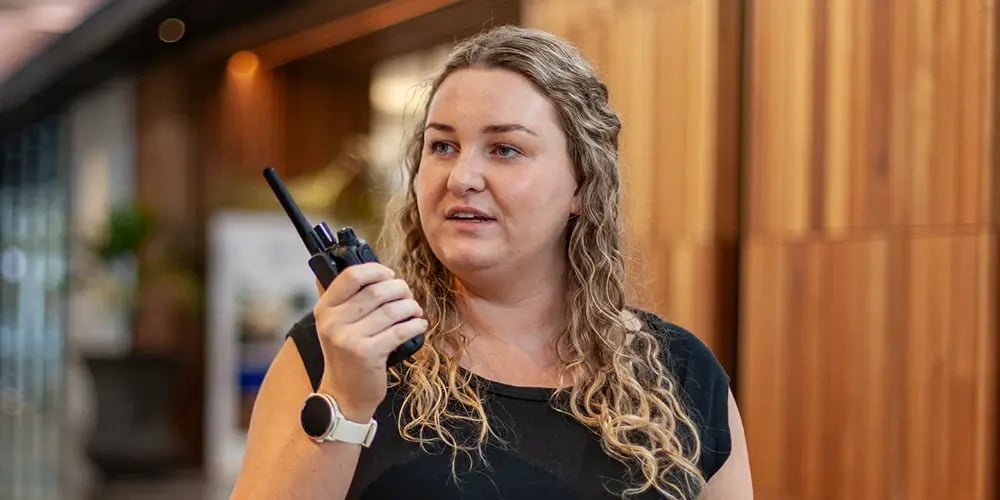
Why teams continue to choose radio
Ultimately, every communications technology involves trade-offs. The right solution depends on the type of information being shared, the environment in which teams operate, and the impact communication has on day-to-day operations.
For some organizations, particularly those that rely heavily on real-time team coordination, this evaluation process may highlight the strengths of professional radio systems.
Private radio networks can be designed around a team's operational and resilience needs, with coverage focused on where communications are required and options for backup power, and off-network communications. Purpose-built devices offer dedicated push-to-talk controls, rugged construction, and extended battery life to help teams stay connected through demanding conditions.
Together, these capabilities can support communications designed around the realities of an operation and help strengthen safety and business continuity as well as day-to-day coordination.
That is why radio continues to play an important role even as cellular and Wi-Fi capabilities expand. The question is not whether radio is more advanced than broadband technologies, but whether purpose-built communications are a better match for the requirements of the operation.
Choosing the right solution for your operation
There is no universal answer to the question of whether cellular, Wi-Fi, or radio is the best communications technology. The answer can involve using a mix of multiple technologies that best meet your operational environment, communication requirements, and business objectives.
When evaluating options, consider:
-
What impact would communication failure have on operations?
-
What information do employees need to communicate?
-
Where do people work?
-
How quickly must teams communicate?
-
Do employees primarily require voice, data, or both?
-
How much control do you need over communications availability and performance?
When radio is the right fit
Radio is designed for organizations that need reliable voice communication across a defined operational area. Different types of systems support different levels of capacity and complexity.
Smaller teams may need simple, reliable communications across a single site or defined area. More complex operations can require greater capacity and wider geographic coverage, with networks designed to support the resilience expected by public safety agencies, utilities, transport operators, and other critical services.
Tait PTToX can also work alongside radio systems, connecting broadband users over LTE or Wi-Fi with DMR and P25 radio networks, while multibearer devices can operate across broadband and LMR.
The right approach depends on the scale and complexity of your operation and the level of resilience you need.

Start the communications conversation with the way your team works
The most successful communications investments begin with operational requirements, not technology preferences. Your goal shouldn’t be to choose the technology with the longest feature list. It should be to give people communications that fit the way they work and continue supporting them when communications matter most.
Still not sure which technology is right for you?
COMMENTS