



With over 30 years of engineering experience, Blad Guzman (now Project Implementation Engineer Manager at Tait) has seen plenty of technology changes across the industry. Here, he explores the possibilities and potential traps of using AI technology in the mission-critical space.
Every major technology wave arrives with promises of greater efficiency, and artificial intelligence is no different.
Across industries, much of the conversation centers on automation, productivity, and what AI can do faster or more efficiently than people. While those are important considerations, they do not fully reflect the realities of mission-critical environments where the objective is not simply efficiency, but enabling better-informed decisions when conditions are complex and consequences matter most.

The organizations responsible for public safety, transportation, utilities, and other critical operations must evaluate technology differently. When decisions affect essential services and community safety, any technology involved must also be highly dependable under pressure, support informed decision-making, and operate within clearly defined lines of accountability.
From my perspective, this is where the conversation around AI becomes more complex.
Whether AI can automate a task or identify a pattern is only the first step. I believe the more important question is whether it can provide meaningful support, even in challenging conditions. It needs to help operators make sense of increasingly complex situations and its influence must be understandable, attributable, and defensible.
To understand why AI must be evaluated differently in mission-critical environments, it helps to examine three realities that set these types of organizations apart.
Reality 1: Conditions are rarely ideal in mission-critical environments
AI is often discussed as though reliable connectivity, relevant data, and stable operating conditions can be assumed. Mission-critical operations cannot make those assumptions.
Communications systems often matter most when infrastructure is damaged, information is incomplete, networks are congested, and operators are managing rapidly evolving events under pressure. That changes how any new technology must be evaluated.
Technology that performs well during routine operations but becomes unreliable when information is missing or systems are under strain introduces a new source of risk rather than reducing one.
This does not mean AI has no role to play. In fact, some of its most promising applications may emerge in these complex environments. The challenge is knowing where AI can add value, where its limitations lie, and how those limits become visible to the people relying on it.
As AI becomes more integrated into operational workflows, mission-critical organizations will need to ask different questions:
-
How does the system respond to uncertainty?
-
How does it communicate incomplete information?
-
Can operators recognize when confidence is low or context is missing?
-
And perhaps most importantly, does it help people maintain clarity when situations become more complex?
Because in mission-critical environments, success is not measured by how a technology performs under ideal conditions. It is measured by how it supports operations when conditions are anything but ideal.

Reality 2: Human judgment remains essential
Transcribing communications, translating information, or organizing operational records are fundamentally different from deciding how to respond to an unfolding incident. The former are tasks that can be bounded and checked. The latter requires experience, context, judgment, and clear responsibility.
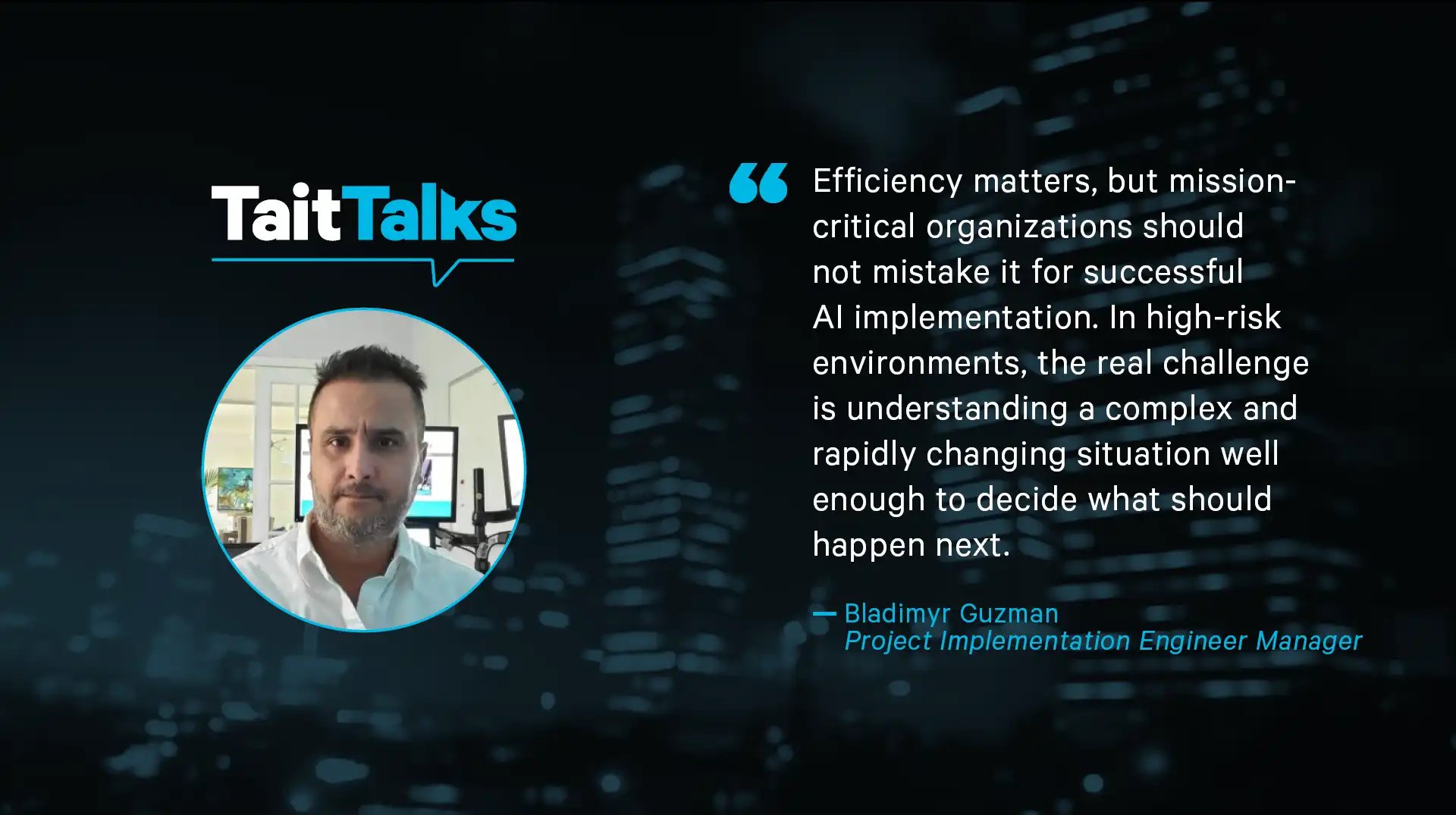
Efficiency matters, but mission-critical organizations should not mistake it for successful AI implementation.
In environments where decisions affect public safety and critical infrastructure, understanding a complex and rapidly changing situation well enough to decide what should happen next is the real challenge.
This distinction between efficient automation and effective situational awareness matters because mission-critical environments generate large amounts of information across a range of communications systems, operational applications, location services, sensors, alerts, network events, and historical records. These sources can all contribute valuable context, but more information does not automatically create greater awareness. But in many cases, all this information can increase cognitive load and make it harder to identify what truly matters in the moment.
I have seen this firsthand in projects where intermittent RF interference affected network performance and took days of engineering effort to isolate. Engineers correlated alarms, reviewed logs, conducted drive testing, and eliminated possible causes one by one. The problem was not collecting data. It was finding the meaningful pattern hidden among thousands of normal operational events.
This is where AI has the potential to make a meaningful contribution. An AI capability that analyzes telemetry, performance trends, and spectrum activity could help identify anomalies earlier and narrow the search space.
More broadly, AI’s greatest value may lie in improving situational awareness. When faced with a mountain of information and data points, AI can help operators and decision-makers identify relevant information, recognize emerging patterns, and gain context more quickly, supporting faster and better-informed decisions while keeping human judgment at the center of the process.
The engineer still determines the root cause and decides what action to take. The difference is that they can arrive at that conclusion with greater awareness and better context.
AI may change the quality and speed of the information available, but not who is responsible for interpreting it and deciding what happens next.
Automate the routine. Support the judgment.

Reality 3: Accountability cannot be delegated
For me, the most important governance question is deceptively simple: Who is accountable when critical operational decisions are influenced by AI-generated insights?
As AI becomes more deeply embedded in operational workflows, its influence over decisions must remain transparent and accountable. Yet much of the industry discussion still centers on capability. Mission-critical organizations also need to ask:
-
How will AI-generated recommendations be validated?
-
Can operators understand what informed an output?
-
What happens when human judgment conflicts with an AI recommendation?
-
What level of oversight is appropriate for each operational use?
As AI moves beyond routine administration and begins shaping operational awareness, its influence introduces responsibility and that responsibility must remain with the people and organizations making operational decisions. The technology cannot be held accountable.
That makes clear governance essential: where AI can be used, when its outputs can be trusted, what requires human authorization, and how its influence can be reviewed afterward.
Organizations must also consider issues such as data quality and auditability. If an AI capability prioritizes an alert, recommends an action, or changes the information presented to an operator, the organization should be able to establish what information informed the output and who made the final decision. That means outputs should be bounded and auditable, with a verifiable identity where consequential actions are involved.
Because in mission-critical environments, accountability cannot be added later. It must be designed in from the beginning.
Why openness matters more in an AI-driven future
The three realities explored here are not new. Mission-critical organizations have always operated under imperfect conditions, depended on human judgment to navigate uncertainty, and maintained clear accountability for operational decisions.
What is new is the way AI capabilities are bringing these requirements into sharper focus.
As organizations explore more operational uses for AI, they are exposing the broader challenge of having valuable information distributed across systems, platforms, and workflows. Without the ability to connect those environments, the value AI can deliver is limited.
Strong architecture and interoperability create the foundation that allows information to move across systems, helping AI-enabled capabilities surface meaningful insights while giving organizations visibility into how technologies interact.
In this sense, AI is not changing the fundamental requirements of mission-critical operations, but it is exposing how important those requirements have always been.
Capability is only the beginning for mission-critical AI
AI continues to create new possibilities for mission-critical organizations. But possibility is not the same as operational readiness.
Organizations need to look beyond individual use cases and consider the wider environment in which AI will operate, including the information it can and cannot access, the limits placed on its role, and the people who will take responsibility for the outcomes.
I do not believe the objective in high-consequence situations should be maximum automation or the replacement of human decision-making. The objective should be to use AI responsibly to provide greater clarity, improve situational awareness, and help people make better-informed decisions when the consequences matter most.
Capability may earn AI consideration. Trust will determine whether it earns a lasting place in mission-critical operations.
COMMENTS