




Tait Video Solutions are currently offered in Asia Pacific and Europe.
As video becomes embedded in safety, investigations, compliance, and frontline decision-making, organizations are placing greater demands on the systems behind their cameras. A platform that works for today’s deployment may struggle to keep pace as footage volumes grow, regulations change, and operational systems become more connected.
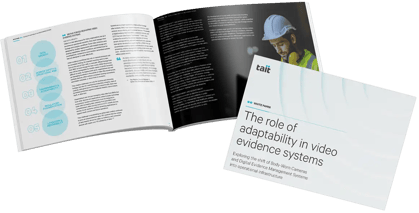
Our latest white paper explores why adaptability is emerging as a key factor in choosing a video evidence system.
Video is growing faster than many systems were designed to handle
Video evidence is increasingly being used across public safety, transportation, utilities, healthcare, inspections, private security, and government organizations. And the market continues to expand.
-
The global market for law enforcement cameras, video systems, and evidence management platforms was valued at approximately US$2.2 billion in 2024
-
It is forecasted to reach US$4.2 billion by 2029
-
Commercial body-worn camera (BWC) shipments are expected to quadruple by 2029
Source: Omdia Body Worn Cameras & Digital Evidence Management – 2025 Analysis
At the same time, organizations must manage increasing volumes of footage, longer retention requirements, growing privacy obligations, and demands for faster evidence retrieval.
Systems designed around narrower operational scope may require significant customization, replacement, or workaround processes to adapt to these changing requirements.
Why adaptability matters for video systems
Today, many video evidence systems are expected to do far more than store footage. Depending on operational needs, organizations may need systems that can:
-
Integrate with dispatch platforms
-
Connect with records management systems
-
Support live streaming
-
Automate evidence workflows
-
Enable AI-powered search and redaction
-
Support evolving privacy and governance regulations
-
Scale as data volumes increase
When systems cannot adapt, organizations can face growing operational friction, increasing costs, and fewer future technology choices.
Open versus closed systems
One of the key factors influencing adaptability is the architecture of the video evidence ecosystem itself and choosing to adopt an open or closed video evidence ecosystem may be one of the most important decisions organizations face.
Closed systems sometimes offer simpler deployment and more direct hardware-software integration within the vendor's ecosystem. However, they can also introduce challenges such as:
-
Vendor lock-in
-
Limited third-party integrations
-
Reduced data portability
-
Greater difficulty adapting to future requirements
Open systems are designed to integrate with broader operational environments and allow organizations to evolve their technology stack over time. However, supporting an open standard does not necessarily guarantee interoperability. Buyers should verify supported versions, implementation scope, documentation, licensing, and the ability to exchange complete evidence packages without proprietary conversion or metadata loss.
Especially for organizations already operating CAD, RMS, CCTV, analytics, or control-room technologies, openness becomes increasingly valuable as operations become more complex.
Questions every organization should ask
Adaptability is difficult to evaluate through feature lists alone. Instead, organizations should test how a platform will perform as needs and requirements evolve.
-
Can it integrate with systems we already use?
-
Can it adapt to regional regulatory or reporting requirements?
-
How will it affect day-to-day operations?
-
What is the true long-term cost of ownership?
-
How will it support future technologies and workflows?
-
Can claims of openness be demonstrated?
The answers to these questions may have a greater impact on long-term success than individual product features.
The bigger shift in video evidence
The camera may capture the event, but the wider evidence system determines whether that footage remains secure, searchable, shareable, and useful as operational demands change.
Video evidence systems are increasingly becoming operational infrastructure rather than standalone tools. The organizations that prepare for that shift now will be better positioned to integrate new technologies, meet evolving requirements, and avoid costly platform limitations later.
Want to explore the full findings?

COMMENTS